HOW TO CLEAN YOUR GLASSES
GLASSES MUST ALWAYS BE CLEANED WITH CARE.
Most RIEDEL glasses are dishwasher-safe and can withstand at least 1,000 cycles without noticeable loss of shine or clarity when loaded and washed correctly. Their dishwasher resistance has been tested in accordance with EN 12875-1:2005 and EN 12875-2:2001.
RIEDEL glasses marked "hand wash only" or "not dishwasher safe", or delivered without care/cleaning instructions on their packaging, should be washed by hand and not in the dishwasher.
LOADING AND USING THE DISHWASHER:
- To take good care of your glasses, the use of aggressive detergents should be avoided and a short cycle wash at low temperature should be selected,
- When loading glasses into a dishwasher, make sure to leave enough space between them to prevent them from touching each other or coming into contact with other objects,
- Place your glasses preferably in the top rack of the dishwasher and use a glass holder if possible. To prevent your glasses from sliding during the wash cycle, installing a glass holder helps hold the glasses better in place. When loading, make sure that the glasses do not touch other objects such as metal utensils or cups; position your glasses so that they do not come into contact with other supports or the wash arms,
- Some RIEDEL glasses may be too large to be placed in the top rack of the dishwasher. If your dishwasher has a special glass program, you can carefully place your glasses in the bottom rack following the instructions above; otherwise, they must be washed by hand.
- If possible, use a glass holder to position the feet in the dishwasher, which will hold the glasses in place and prevent them from moving,
- to avoid streaks or turbidity: use soft water (low in minerals),
- To prevent scratches: Avoid contact between the lenses or with other materials such as metal,
- Use high-quality dishwasher tablets specifically recommended for glass care; as an eco-friendly alternative, you can also use white vinegar as a rinse aid for optimal shine.
PREPARING THE DISHWASHER:
ENSURE THAT THE DISHWASHER IS PERFECTLY PREPARED OR SET.
This means:
- rinse aid: your rinse aid must be correctly dosed, well calculated for the cycle; make sure that your dishwasher always has a sufficient quantity of rinse aid,
- Water softening: Extremely soft water can damage glass; the dishwasher's water softening system must be set according to the water hardness in your home and must correspond to a value of approx. 3 to 4 degrees of hardness - German scale (°dH),
- temperature and program selection: for washing glasses, select a low temperature program (50 - 55 °C) or a special glass program if your dishwasher offers it,
- steam: after washing, briefly open the dishwasher door (if it is not automatic) to allow moisture to escape, as steam can accentuate a whitish deposit on the surface of the glass,
- food residues and fruit juices: large quantities of food residues and/or fruit acids, such as those in juices, can have an effect on the composition of the washing liquid and therefore the quality of the washing cycle; therefore, it is advisable to rinse these dirty dishes under water;
- Avoid washing your glassware with household utensils made of aluminum (e.g. garlic presses, pans with aluminum handles, etc.), as this can cause chemical reactions between the aluminum and the surface of the glasses; this can significantly accelerate the clouding process of the glass.
HAND WASH AND DRY/POLISH:
- When washing your glasses by hand, clean them gently with lukewarm clean water (use dishwashing liquid and rinse gently); avoid using water that is too hot or boiling for rinsing,
- To remove surface stains: soak the glasses in a white vinegar solution,
- To avoid any residue from the dishwashing liquid, rinse the glasses thoroughly with clean water,
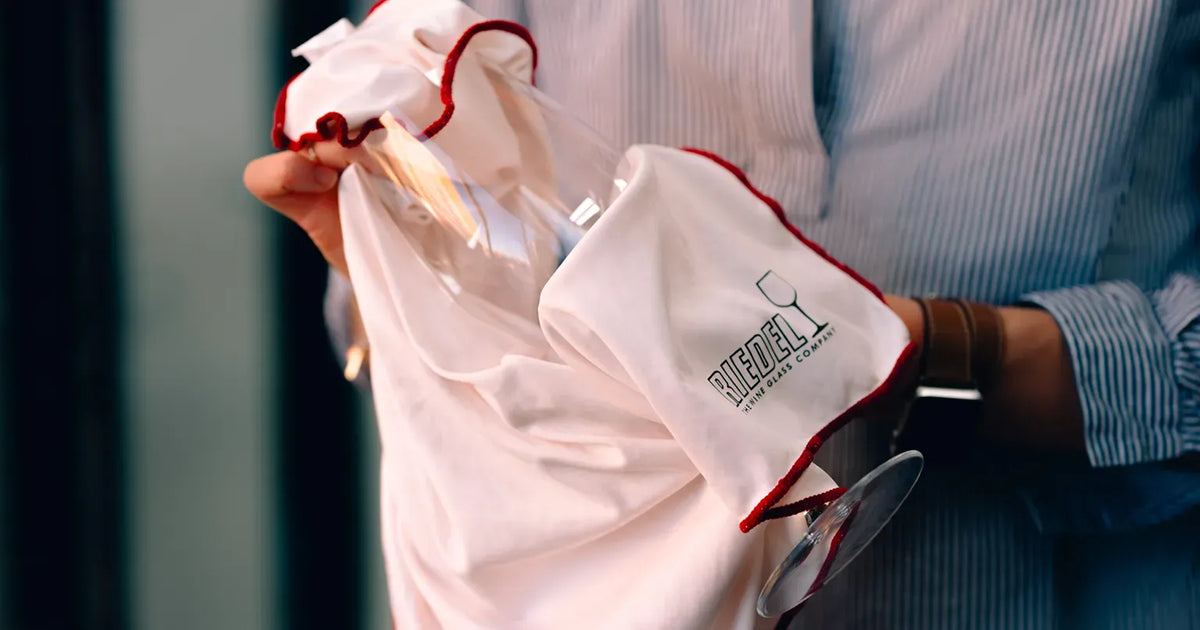
- use two large microfiber cloths to dry and shine your glasses,
- When drying or polishing glass, never hold the stem and the chalice at the same time, as twisting or pressure could break the stem,
- When drying or polishing glass, never hold the stem and the chalice at the same time, as improper handling could cause the stem to break at the narrowest point.
- First, hold the glass with one hand, placing the glass wiper directly under the chalice, and gently wipe the inside of the chalice, then move to the outside with the other hand using a second glass wiper; then, firmly hold the glass by its stem with one hand and gently polish this last part with the other hand,
- Avoid leaving your glasses to dry upside down on a metal rack, as this could damage the edges,
- Do not use a cloth to dry or polish, as it could damage your glasses; instead, use two microfiber cloths.
- We recommend using RIEDEL microfibre glass cloths, which dry easily and do not fluff when washed properly (see below),
- Wash your glass cloths at a temperature of 60°C/140°F (to kill bacteria) with an unscented detergent,
- Do not use fabric softener when washing your microfiber cloths; this helps prevent a film from forming on the surface of the glass.
- Caution: Do not put your microfiber cloths in the dryer.
STORAGE
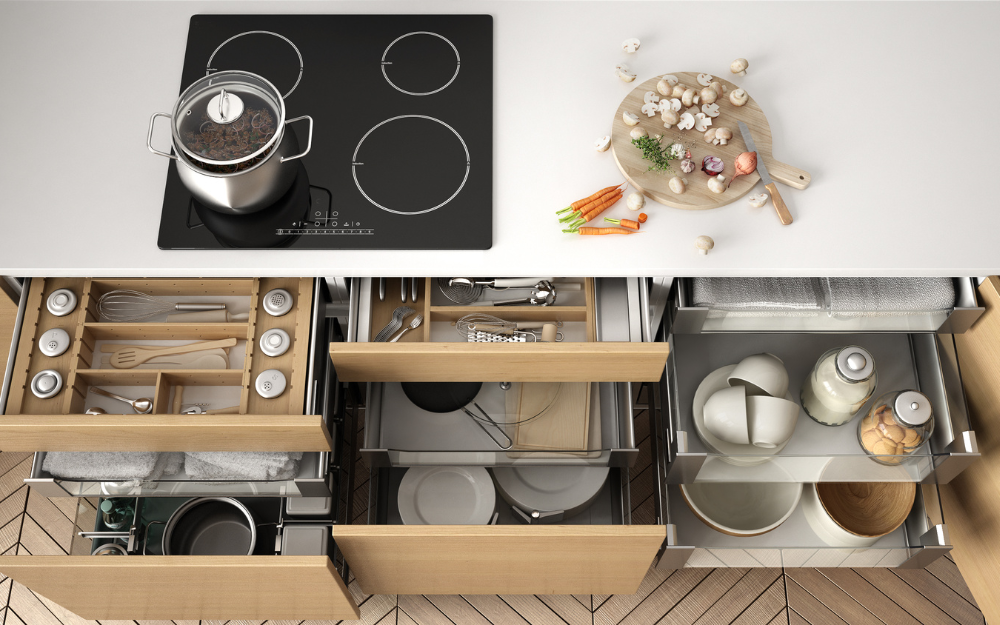
Avoid storing glasses in kitchen cupboards where strong-smelling items are located, as this can discolor the glass and alter the aroma of the wine.
PREVENTION OF GLASS OPACITY
The cloudy appearance of a dishwasher-washed glass can have two causes. Most often, the cloudiness is due to limescale deposits or detergent residues. These can be easily removed with weak organic acids (e.g., citric acid or white vinegar). However, there are also cloudinesses that, according to current knowledge, are not deposits but changes in the glass surface. This white haze cannot be easily removed with household remedies because it is caused by the glass components leaching from the surface. To prevent this cloudiness, it is best to rinse glasses immediately after use so that no remaining beverage or wine remains. Particular care should be taken with red wine, as its acid attacks the glass if left for too long.
Glass is a material that delights the observer with its brilliance and transparency. However, these characteristics mean that any damage to the glass surface - however small - is immediately visible. Therefore, a permanent haze of the glass is already clearly visible to the connoisseur, even though the glass is only affected to a depth a thousand times less than 1 mm. In principle, every glass undergoes a process of optical change over time. The cause of this opacity is often difficult to determine, but it is possible to counteract damage to the glass surface during washing in the dishwasher.

HOW TO CLEAN YOUR DECANTER
DECANTERS AND CARAFES SHOULD ALWAYS BE CLEANED CAREFULLY.
Most RIEDEL decanters should be hand washed unless otherwise specified.
It is important to immediately rinse the decanter or carafe with clean water after each use; fill your item with lukewarm water and leave it overnight. The next day, discard the water and fill the decanter or carafe with approximately 1/2 liter of distilled water. Swirl the distilled water around and discard it. A solution of water and lemon juice or vinegar essence can also be used to clean your decanter; however, rinse it thoroughly afterward to avoid any odors.
Allow the decanter to dry, then dry by polishing the exterior with a microfiber cloth.
Be careful not to hit the spout of your decanter against the faucet as this could chip it. If your decanter is too large for your sink, you can also wash it in a bathtub or shower.
Avoid using dish soap or detergents to clean decanters, as it can be very difficult to remove all residue.
To prevent clouding, always rinse your decanter or carafe immediately after use with clean water; this helps prevent traces of wine deposits. Be especially careful with red wine if any wine remains in the decanter, as its acid attacks the glass. For stains, you can also try special glass cleaning tablets.
Cleaning beads can help remove stubborn stains from the inside of your decanter or carafe. Simply fill the decanter with warm water, slowly and gently pour the cleaning beads into the decanter using a funnel, and swirl them around for about two minutes. Then, carefully remove the beads by collecting them in a fine-mesh strainer; then rinse and dry them for storage.
NOTE: More cleaning recommendations from Maximilian J. Riedel: https://www.youtube.com/watch?v=WyjKRcwvE08 and https://www.youtube.com/watch?v=SKSQ8K1d9lY